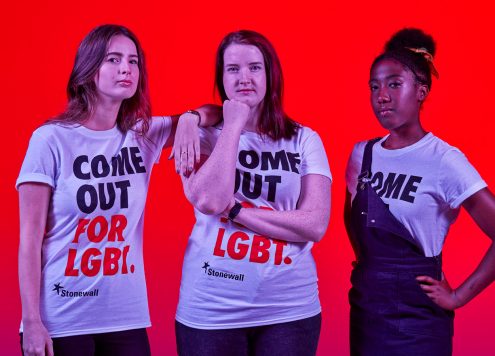
Despite having been an activist – or at least involved in activist circles – for almost half a decade, I have never felt like that label was mine to claim. Even when I was named as Stonewall Young Campaigner of the Year, I was reluctant to use the title of ‘activist’. Was it the quality of work I doubted? Or my capacity to enact positive social change? Nope – it was because of my age. After all, how much impact can a teenager making videos in her bedroom have? Well, as it turns out, quite a lot.
If an activist is someone who campaigns for political and social change, then it is clear that, in the UK and across the world, we have whole swathes of young activists toiling away, putting their blood, sweat and tears into creating a better future for themselves and others. Oftentimes, youth activism remains unnoticed by adults because it is taking place in schools, or student assemblies or youth councils and frequently deals with issues affecting young people, making the youth contribution to activist movements more distant, and easier to ignore. Consequently, young activists are not always receiving the support they need, from organisations they work with, from their places of education, or from other, older activists.
You might be wondering ‘well, what support could young activists possibly need?’, and I’ll be honest, often we are asking the same questions of ourselves. Many of the young people I know began their activism work with no support and many of us are very successful in our work, but that does not mean we wouldn’t appreciate some help.
“There is a potential for organisations to simply use young people and their time, energy and resources for their own gain.”
Youth involvement in activism has become increasingly popularised in recent years, with many organisations now running campaigning or advocacy programmes which train and support young activists. These programmes can be a brilliant experience, providing invaluable life skills and support to young people; indeed my time on the Stonewall Young Campaigner’s Programme was outstanding, with comprehensive training provided and a mentor with whom I was in regular contact who offered support and advice because it was recognised that I might not, as a young person, have all of the answers all of the time.
But, it is always worth bearing in mind that there is a potential for organisations to simply use young people and their time, energy and resources for their own gain. Thankfully, no one I have spoken to has had this experience (though I don’t doubt it exists) but it never hurts to be cynical when so many people will gladly devalue a young person’s labour.
Unfortunately, where I do frequently see a similar phenomenon occurring, however, is in our schools. The current educational climate is one where unfortunately schools’ budgets, timetables and teachers are stretched beyond their capacity, and yet there is (quite rightly) increasing demands for greater commitments to equality & diversity, to mental health support and a vast array of other areas. Although I would like to think many schools would be willing to do the best by their pupils, the training and capacity is often simply not there. The result? Young people are driving the change they want to see. Of course, this change can be brilliant for all concerned, but the reliance upon young people as the catalyst and for them to take – often sole – responsibility for affecting positive change also has the potential be incredibly burdensome and damaging, putting young people at risk.
In my time tackling LGBT+ inequality in schools I have frequently seen how affecting change relies on young people coming out, for example, or otherwise making themselves vulnerable before they feel they can (and on some occasions so that they can) begin to change their environment. I worry deeply that the over-reliance upon young people – who are often working without support – places them in vulnerable positions. Many young people I have spoken to over the past few years often felt ‘used’ by their schools and that they were ‘doing all of the work’ whilst oftentimes receiving no recognition of their efforts or the struggles they endured in enacting change. Schools need to recognise where they may be over relying on young people to do the dirty work, evaluate their support mechanisms and reflect upon their own investment into improving life for students.
“Young people can be educated and informed, but that is something we work upon — it isn’t automatic.”
Of course, not all young activists will be tackling issues in an educational environment or as part of a programme. Young people across the world organise around a variety of political and social issues, and often this is happening online. The internet can be an incredibly useful form of activism which is often more accessible for young disabled activists or young people who have not come out yet. At the same time, however, discussions can also rapidly become toxic and I’m not just talking about in the comment sections of articles. All too often I have seen adults attack or publicly shame young people when they do something ‘wrong’, with no consideration of the age or intentions of the person.
As a disabled queer girl I understand the anger and frustration that can come when you see someone using offensive language casually, or failing to acknowledge structural oppression, but I think with young people it is always worth initially giving them benefit of the doubt. Young people can be educated and informed, but that is something we work upon — it isn’t automatic and we have simply had less time to learn. I’m not suggesting for a moment that you should not raise your concerns with the young person, but I would recommend doing this privately, rather than publicly, to give us time and space to reflect upon where we might have slipped up, directing us to resources and information if you are able to. In the past I know I have been guilty of using things such as casual ableist language when making a point and whilst that was not okay, it is only because people were able to raise their concerns with me and direct me towards more information that I was able to amend my behaviour. Had I been called out publicly or shamed, I might well have refrained from ever saying anything at all for fear of making a mistake.
Although this advice can be applied somewhat universally across the age groups, it remains clear that young activists do require specific help. It can never hurt to ask a young activist how you can help them; to let them know that you will support them where you can. Trust me on this.
—
Image via Young Stonewall